
Visual schedules for real daily life
Visual Schedules: A Practical Guide for Autism, Kids, Teens, and Adults
A visual schedule makes the order of a routine easier to see. It can show a whole morning, a few steps, a school or work block, an appointment, or simply what happens next — using objects, photos, icons, words, or a combination that fits the person using it.
The goal is clarity, not compliance. A useful visual schedule should make the plan easier to understand and return to. It should not become another way to pressure someone through a difficult moment.
Start with the concept
What is a visual schedule?
A visual schedule is a sequence someone can look at to understand what is happening, what comes next, what has changed, or when a routine is finished. It may use real objects, photographs, picture symbols, simple icons, written words, checkboxes, or a mix.
The schedule does not have to cover an entire day. A bathroom routine, leaving-the-house sequence, homework block, classroom transition, work opening routine, or bedtime sequence can all be visual schedules.
Make the order visible
Instead of holding every step in working memory, the person can look back at the sequence as often as needed.
Make progress visible
Finished activities can be checked off, moved, turned over, removed, or simply recognized as complete — whichever interaction is useful and accessible.
Make changes visible
When plans shift, update the schedule so the visual matches reality. A schedule is most trustworthy when it changes when real life changes.
A visual schedule is not automatically a picture schedule. Pictures can be useful, but some people understand real objects, photos, text, neutral icons, checklists, or mixed formats more quickly. Match the representation to the person rather than the person’s age label.
Visual schedule autism guide
Visual schedules for autism: make the plan easier to see
Visual schedules are commonly used with autistic children, teens, and adults because they can make sequence, transitions, and changes easier to refer back to without relying only on spoken language. They are a support option, not a requirement for every autistic person.
For autism support, the most useful question is usually not “What should an autism visual schedule look like?” It is “What information does this person need to see, and what kind of representation do they understand?”
Transitions
Show what is ending and what follows before the change happens. For one difficult switch, a shorter First-Then board may be easier than a full schedule.
Predictability
Keep the sequence available so the person can check what is coming instead of needing the plan repeated verbally each time.
Changes
Use a changed tile, moved item, replacement activity, or other clear visual update when the plan changes. Do not pretend the original schedule is still true.
Avoid the “more visuals must be better” trap. Some people want the entire sequence visible. Others do better with only the current activity or the next two steps. If a full schedule adds pressure or becomes visual clutter, show less.
Visual schedule for kids — and beyond
Visual schedules can grow with the person using them
A visual schedule for kids may use larger pictures and hands-on tiles. A schedule for a teen or adult may use discreet icons, words, time information, or a phone. The underlying job is the same: make a sequence easier to see.
Young children and early learners
Use concrete, easy-to-recognize visuals and short routines. A movable physical board can be especially useful when touching or moving the next cue is part of understanding the routine.
Teens
Use the level of visual detail the teen actually wants. Neutral icons, text-forward schedules, dark presentation, timers, and discreet on-device views may fit better than childlike picture cards.
Adults
A visual schedule can be a work sequence, self-care routine, appointment plan, meal-prep flow, household routine, study block, or another external structure for steps that are hard to keep in mind.
ADHD and executive-function note: visual routines may also be useful when the challenge is starting, sequencing, remembering steps, or returning to a routine after distraction. The schedule is an external support, not an ADHD treatment.
Real-life visual schedule examples
Start with one routine that actually happens
You do not need to organize an entire life before a visual schedule can be useful. Pick one routine, transition, or recurring sequence that would be easier if the order stayed visible.
Morning visual schedule
Useful when getting out the door requires the same steps but the sequence keeps disappearing in the rush.
Bedtime visual schedule
Keep the routine familiar while still updating the schedule when the evening changes.
Classroom or school schedule
A classroom schedule can show broad periods, one center rotation, an arrival routine, packing up, or another repeatable school sequence.
Homework, study, or work block
Useful when the challenge is knowing where to start, how the block is structured, or what “done” looks like.
Leaving-the-house routine
Pair the sequence with a visual timer only when seeing time is genuinely useful. The timer answers “how long”; the schedule answers “what is next.”
Appointment or unfamiliar-event schedule
Use broad steps when every detail is not known. If the main need is previewing what may happen in a new situation, a visual story may also fit.
How to use a visual schedule
Build the smallest schedule that answers the question
There is no universal correct number of pictures, tiles, or steps. Begin with the smallest amount of information that makes the routine understandable, then adjust based on what the person actually uses.
Choose one routine or sequence
Morning, bedtime, bathroom, leaving, homework, a school transition, a work block, or another repeatable sequence is easier to test than a full-day overhaul.
Break it into clear, observable steps
Use labels such as “shoes,” “pack bag,” or “brush teeth” rather than vague directions such as “be ready” or “behave.” The schedule should tell the person what the step actually is.
Choose a representation the person understands
Objects, photos, icons, drawings, words, or a combination can all work. Do not assume more detailed pictures are automatically more helpful.
Show how to check what is next
Point to the schedule, tap the current item, move a tile, mark a checkbox, or use another clear interaction. The goal is for the schedule itself to become a useful reference.
Make the finish visible
Some people like moving completed items to “finished.” Others prefer checking them off, fading them, or simply advancing to the next step. Use the completion signal that fits the person and format.
Change the schedule when real life changes
If the plan changes, update the visual. A schedule becomes less useful when the person learns that what it shows cannot be trusted.
Choose the representation
Should a visual schedule use objects, photos, icons, or words?
Use the form the person recognizes and wants to use. Visual schedules can become more or less picture-forward over time, and different activities may need different kinds of cues.
Useful when an actual object or object cue is more meaningful than a flat picture.
Useful when a specific place, item, or familiar real-world cue matters.
Useful when a simple reusable symbol is easier to scan across many routines or settings.
Useful for readers who prefer less picture-forward or more discreet support.
There is no universal “best” visual. A photo can be clearer for one activity and distracting for another. A simple icon may travel better between home, school, and community settings. A word may be exactly enough for a reader who does not want pictures.
How many steps should a visual schedule have?
Show enough information to help — not automatically the whole day
A full schedule is useful when seeing the sequence is part of the support. It is not automatically better than a small routine. The right amount can change by activity, setting, energy level, and familiarity.
Two steps
When the important question is simply “what happens after this?”, use a First-Then board.
A short routine
Use a handful of steps for hygiene, packing up, homework, bedtime, leaving the house, or another contained routine.
A fuller sequence
Use broader blocks for a school day, workday, travel day, or full routine when seeing the larger order is actually useful.
If the full schedule is becoming another demand, reduce it. In ViziCues, the same routine can move from Checklist to Focus or First-Then without rebuilding the plan. On paper, you can cover later steps, use a shorter strip, or show only the current section.
Plans change
A visual schedule should describe reality, not force reality
Schedules can support predictability without pretending the day is fixed. When something changes, the useful move is to make the change visible and understandable — not insist that the old schedule must still happen.
Show the change
Move, remove, replace, cross out, or update the activity. Use short language such as “Plan changed. Library is closed. Next is home.”
Keep what is still known visible
If only one part changed, leave the rest of the routine intact. Predictability does not require pretending uncertainty is not there.
Use time support only when time is the problem
A visual timer can make waiting or the end of an activity easier to see, but it may add pressure for some people.
Use transition supports when switching is the hard part
If stopping, starting, leaving, or changing activities is the main challenge, use the transition supports guide to choose the smallest support that fits.
Choose how you want to make it
Start with a ready-made movable board — or build the exact routine you need
The useful choice is not “paper or app.” It is whether you want a ready-made tangible template or a custom builder. A ViziCues schedule can stay interactive on-screen or leave the screen as a printed schedule, PDF, image, or shared file.
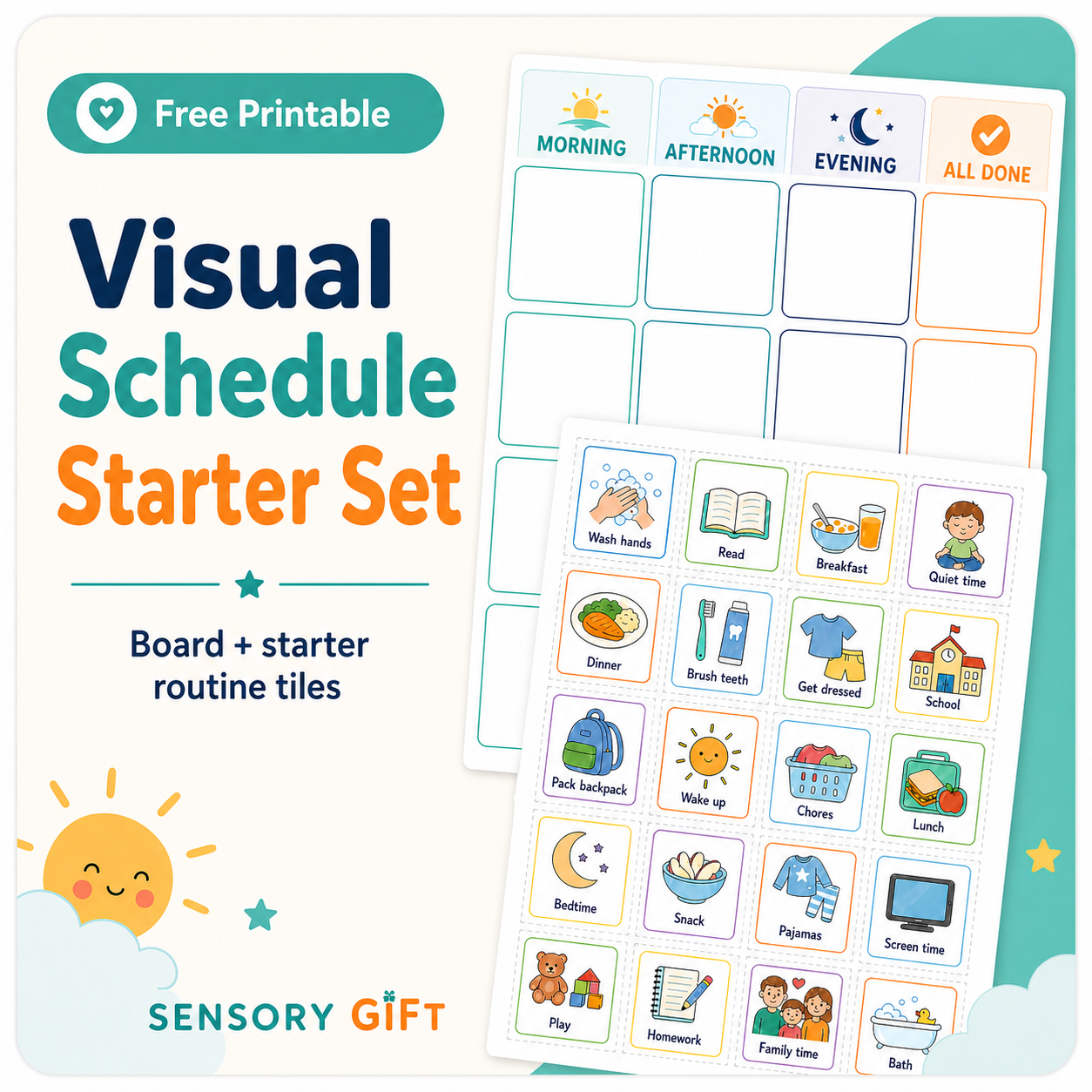
Free movable-tile visual schedule
Start here when you want a physical board you can print, cut, and use without designing the routine system from scratch.
- Ready-made daily board and starter activity tiles.
- Tangible cues that can be moved by hand.
- Useful for younger users and anyone who understands a physical movable system best.
- Can be used without keeping a device in the routine.
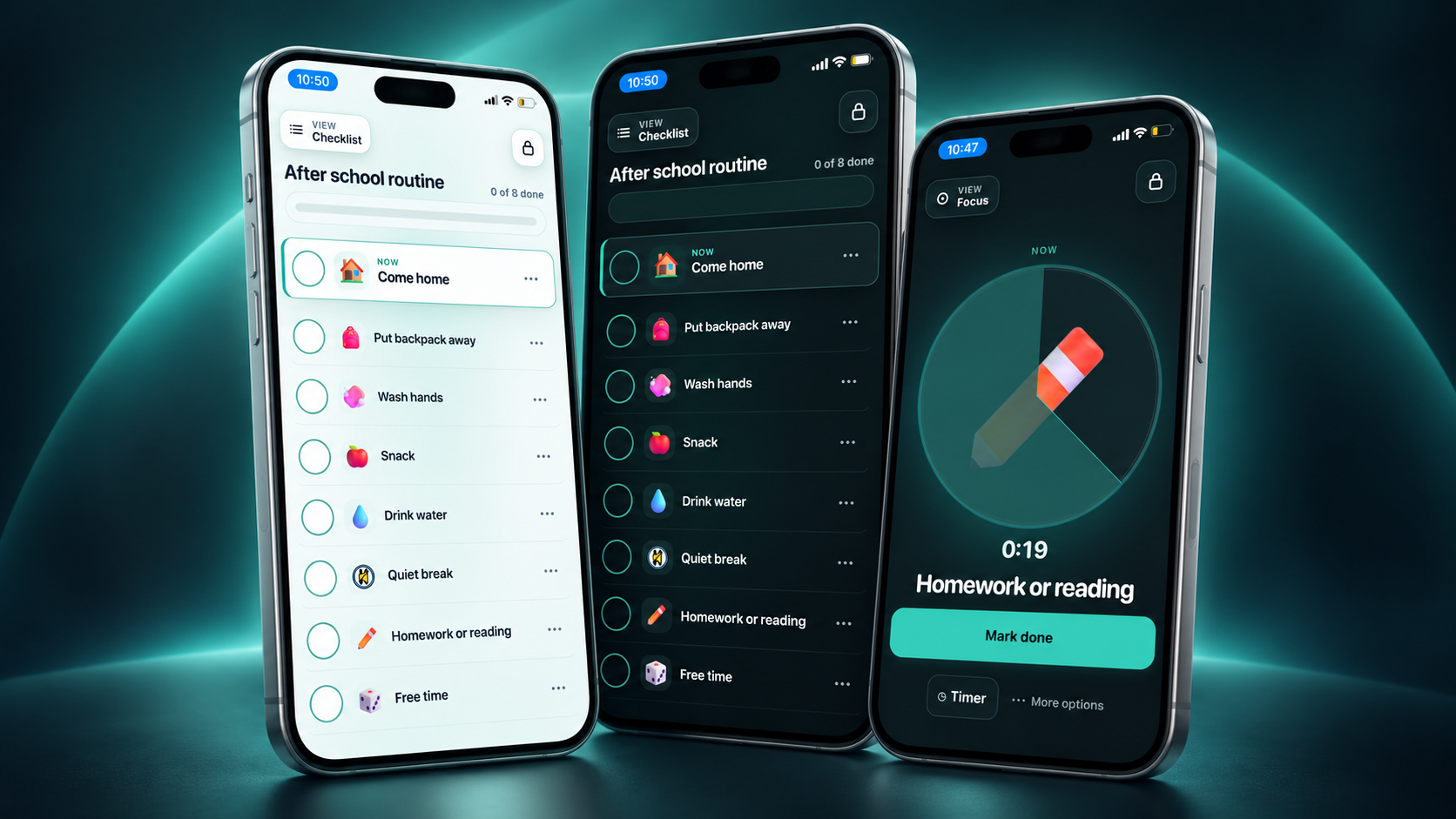
Build a custom visual schedule in ViziCues
Use ViziCues when the routine needs to be customized, edited, reordered, reused, or shown in different amounts of information. The finished support does not have to stay inside the app.
- Build the full routine, then use Checklist, Focus, or First-Then as needed.
- Use Friendly or Discreet visuals and other appearance controls.
- Keep the schedule interactive on a phone, tablet, or browser.
- Print it, save it as PDF or image, or use supported sharing when an off-screen version fits better.
Many people use both. A hands-on movable board may be best for one routine, while a custom ViziCues schedule is easier to change, reuse, print, or share for another. Choose the format by the job, not by a rule that visual schedules must be either “digital” or “printable.”
Choose the support by the question
Visual schedule, First-Then board, timer, or another visual support?
A visual schedule is only one tool. Use the support that answers the information problem in front of you.
| If the hard part is… | Try… | What it makes easier to see |
|---|---|---|
| The order of a routine | Visual schedule | Several steps, a broader sequence, and a visible finish. |
| Only what happens after this | First-Then board | The current step and what follows. |
| How much time is left | Visual timer | Time passing or the approach of an ending. |
| Choosing among a few options | Choice board | Available choices without an open-ended question. |
| A new or unfamiliar event | Visual story | What may happen in an appointment, outing, event, or new routine. |
| Stopping, starting, leaving, or switching | Transition supports | What is ending, what comes next, and what support may help with the switch. |
When the schedule is not helping
Common visual schedule problems — and what to change
If a schedule is ignored, resisted, or making the routine harder, do not assume the answer is more prompting. Look at the support itself.
Too much is visible
Reduce the number of steps. Show one section, use First-Then, or keep only the current activity visible.
The pictures are not meaningful
Try photos, simpler icons, text, real objects, or a different level of visual detail. Representation should be understandable, not merely attractive.
The schedule only appears during conflict
Introduce and practice it during ordinary or preferred routines so it does not become a signal that something difficult is about to be demanded.
The schedule never changes even when life does
Update it. A schedule that regularly says one thing while reality does another becomes less useful as a source of predictability.
The person has no role in it
When possible, involve the person in choosing the format, checking the schedule, moving or marking steps, and deciding how much information stays visible.
The schedule itself feels like pressure
Shorten it, simplify it, change the language, remove unnecessary time pressure, or stop using it in that moment. Support should make the next part clearer, not more threatening.
Questions people ask about visual schedules
Visual schedule FAQ
Short answers to the questions that usually come up when someone is deciding whether a visual schedule fits, how much to show, and which format to use.
What is a visual schedule used for?
A visual schedule is used to make the order of activities or steps easier to see. It can support morning and bedtime routines, school or work sequences, hygiene, leaving the house, appointments, transitions, chores, study blocks, and other repeatable routines.
Are visual schedules only for autism?
No. Visual schedules are widely used in autism support, but they can also be useful for children, teens, and adults who benefit from externalizing sequence, reducing repeated verbal directions, or making a routine easier to return to.
Do visual schedules help autistic children?
They can. A visual schedule may make sequence, transitions, and changes easier to refer back to. It is not helpful for every autistic child, and the format should match the child’s understanding, communication, sensory needs, and preferences.
Can autistic teens and adults use visual schedules?
Yes. The schedule does not need to look childlike. Teens and adults may prefer words, checklists, neutral or discreet icons, dark presentation, a phone-based schedule, or a printed custom routine.
How many steps should I put on a visual schedule?
There is no correct number for everyone. Show the smallest amount that makes the routine understandable. A difficult transition may need only two steps; a short routine may need a few; a familiar school or workday may use broader blocks.
Should a visual schedule use photos, pictures, icons, or words?
Use whichever representation the person understands and wants to use. Real photos can help when a specific place or object matters. Simple icons can be easier to scan and reuse. Written words may be preferable for readers who want a more discreet schedule.
Does a visual schedule need a “finished” area?
No. A finished area can be useful, but it is one option. Some people prefer moving a tile, checking a box, crossing out a step, fading a completed item, or simply advancing to the next activity.
What is the difference between a visual schedule and a First-Then board?
A visual schedule shows more of a routine or sequence. A First-Then board keeps only the current step and what follows visible. Use First-Then when that smaller amount of information is more useful than the fuller schedule.
Can a visual schedule include a timer?
Yes. A timer and a schedule answer different questions. The schedule shows what is happening and what comes next; the timer shows how much time is left. Use time information only when it helps rather than increases pressure.
Should I use a full-day visual schedule?
Only if seeing the full day is useful. Many people do better starting with one routine or a few broad blocks. More visible steps are not automatically more supportive.
What if the visual schedule changes?
Change the visual too. Move, remove, replace, or mark the changed activity and briefly explain the update. A useful schedule should reflect the plan that is actually happening.
What if the person refuses or ignores the visual schedule?
Look at the schedule before adding more prompting. It may show too much, use unclear visuals, appear only during difficult moments, or not match what the person needs to know. Simplify it and practice in a lower-pressure routine.
Is a printable visual schedule better than an app?
Not automatically. A ready-made movable-tile board can be excellent when a tangible physical system fits the person. A custom builder such as ViziCues is useful when the routine needs to be edited, reused, shown in different views, or exported. ViziCues can also produce printable, PDF, image, and shareable schedule outputs.
Can I make a custom visual schedule and then print it?
Yes. ViziCues is built to let you create and edit a custom visual schedule, use it interactively if you want, and then print it or save it as a PDF or image when an off-screen version fits better.
Where can I get a free visual schedule?
SensoryGift has a free ready-made visual schedule template with a routine board and movable activity tiles. If you want a custom schedule rather than a ready-made template, you can build one in ViziCues and use the finished schedule on-screen or export it.
Evidence + further reading
Visual schedule guidance and research
SensoryGift uses a practical, low-pressure approach. These outside resources provide additional guidance on visual schedules and visual supports.
Examples of object, photo, picture-symbol, written, and mixed schedule formats, plus practical guidance for showing what is finished and what comes next.
A visual resource about using schedules to plan activities, understand what comes next, and prepare for changes.
Emphasizes collaboration, choosing pictures or words that fit the autistic person, deciding how much to show, and breaking events into understandable steps.
Research examining visual schedules and transition-related behavior. Individual responses vary, so practical supports should still be adjusted to the person and context.
Important: SensoryGift visual schedules and apps are everyday educational/support tools. They do not diagnose autism or ADHD and do not replace individualized medical, mental-health, occupational-therapy, educational, or other qualified professional guidance.