
Task Paralysis Worksheet: A 2-Minute Unstick Reset for When You Can’t Start
A low-demand printable for ADHD task paralysis, executive dysfunction, overwhelm, and stuck moments when you know what needs to happen but cannot get into the first step.
Prefer a digital option? Open the free Reset app →
Task paralysis is not laziness
Task paralysis is the stuck moment when starting feels unreachable, even when you care about the task and understand that it matters. The task may be too vague, too sensory-heavy, too emotionally loaded, too full of hidden steps, or too hard to begin from your current energy level.
This worksheet does not try to turn that moment into a full plan. It helps you lower one barrier, choose one tiny visible action, and decide on a safe stopping point.
If you want the fuller guide to why starting can feel hard, read Task Initiation Support for ADHD, Autism, and Overwhelm.
Download the free 2-Minute Unstick Worksheet
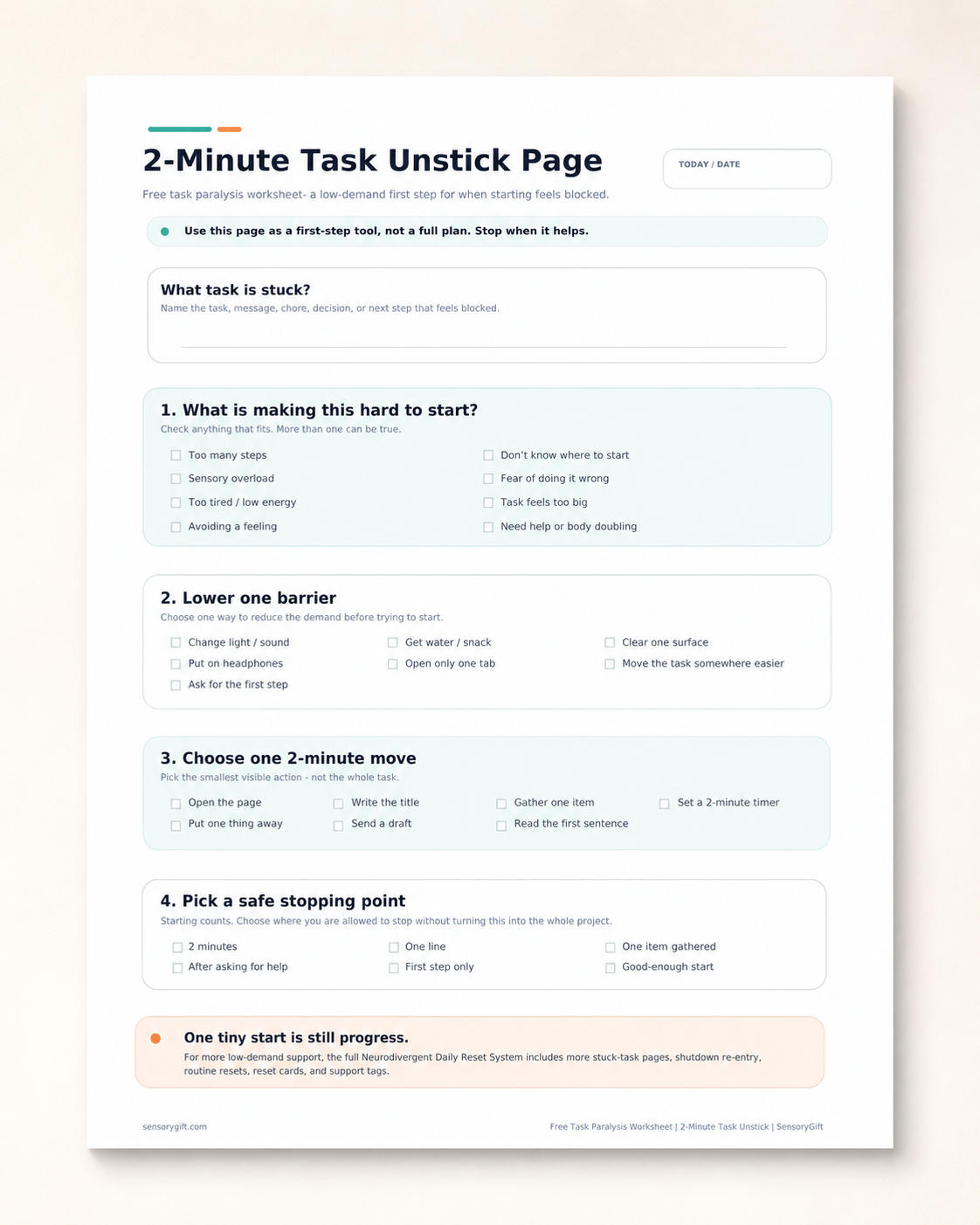
The worksheet gives you one low-pressure path into the task: name what kind of stuck this is, lower one barrier, choose the smallest visible action, and pick a safe stopping point.
It is intentionally short. The goal is not to finish everything. The goal is to make starting feel possible enough.
Prefer guided digital support?
Reset by SensoryGift offers a free digital path for task paralysis and other hard moments. Use it when printing or filling out a worksheet feels like one more step, and you would rather be guided toward one manageable action.
What is task paralysis?
Task paralysis is a common way people describe the freeze that happens before starting, switching, restarting, or finishing a task. It can show up as scrolling, pacing, staring at the task, opening and closing tabs, avoiding messages, or feeling trapped by something that may look simple from the outside.
For ADHD, autism, anxiety, burnout, sensory overload, and executive dysfunction, the hard part is often not the task itself. The hard part is the entry point: figuring out what to do first, tolerating the sensory load, making decisions, and trusting that starting will not turn into an endless demand.
How to use the worksheet in a stuck moment
Keep it boring, short, and kind. This worksheet works best when it reduces pressure instead of becoming another assignment.
Pick the kind of stuck
Choose the reason that fits right now: too many steps, unclear first step, sensory overload, fear of doing it wrong, low energy, task feels too big, avoiding a feeling, or needing help.
Lower one barrier
Change one thing before expecting yourself to begin. Get water, lower sound, put on headphones, clear one surface, open only one tab, move the task somewhere easier, or ask for the first step.
Choose the smallest visible action
Make the first step almost too small: open the page, write the title, gather one item, set a two-minute timer, put one thing away, send a draft, or read the first sentence.
Pick a safe stopping point
Starting is safer when stopping is allowed. Choose two minutes, one page, one object, one sentence, one surface, one email draft, or “stop after setup.”
How to overcome task paralysis without forcing yourself
“Overcome” does not have to mean pushing through until you crash. A more helpful approach is to reduce the entry cost of the task.
- Make the task visible instead of holding it in your head.
- Separate deciding from doing.
- Lower sensory load before starting.
- Choose a time container instead of an open-ended demand.
- Let setup count as progress.
- Stop with a restart note if you cannot continue.
Task paralysis vs executive dysfunction
Task paralysis is the lived stuck feeling. Executive dysfunction is the broader difficulty with starting, planning, sequencing, switching, remembering, regulating attention, estimating time, or following through. A person may use “task paralysis” to describe what the moment feels like and “executive dysfunction” to describe the support need underneath it.
| Term | What it often means | Helpful support |
|---|---|---|
| Task paralysis | The frozen, stuck, unable-to-start moment. | Lower one barrier, choose one tiny action, and use a short stopping point. |
| Task initiation difficulty | Difficulty beginning a task, especially when the first step is unclear or demanding. | Make the first step visible, specific, and small enough to enter. |
| Executive dysfunction | A broader pattern involving planning, organization, working memory, time, decisions, switching, or follow-through. | Use external supports: checklists, timers, templates, visual steps, body doubling, and reset pages. |
For routine-level support, see Executive Dysfunction Daily Routine Support.
ADHD task paralysis
ADHD task paralysis may show up when the task has too many steps, too little novelty, unclear priority, time blindness, decision fatigue, or a delayed reward.
Autistic task paralysis
Autistic task paralysis may be tied to transitions, sensory load, uncertainty, demand pressure, changes in routine, or needing the task sequence to be clearer.
Anxiety, low mood, or burnout
Stress, anxiety, depression, and burnout can make tasks feel heavier. This worksheet is practical support, not treatment. Reach out to a qualified professional or crisis resource if safety is a concern.
When one worksheet helps, but the whole day still feels hard
The free worksheet is for one stuck task. The Neurodivergent Daily Reset System is the fuller printable kit for hard brain-body days: task starters, brain dumps, one tiny step planning, decision relief, sensory overload recovery, shutdown re-entry, routines, leaving the house, time blindness, burnout recovery, reset cards, and support tags.
Use the free page when you need a starting point. Use the full system when you want a reusable support path for many different kinds of stuck, overloaded, low-energy, or hard-to-restart days.
Related SensoryGift supports
These pages connect the worksheet to the bigger support system: task initiation, low-demand routines, executive dysfunction, sensory overload, printable daily supports, and digital help for stuck moments.
Task paralysis worksheet questions
Is task paralysis the same as procrastination?
Not always. Procrastination is often described as delaying a task. Task paralysis is the stuck or frozen feeling when starting feels inaccessible. It can look like procrastination from the outside, but the support needed is often clearer steps, lower demand, less sensory load, or help choosing the first action.
Can this worksheet help ADHD task paralysis?
Yes, it is designed for common ADHD stuck points such as too many hidden steps, unclear priority, low dopamine, time blindness, decision fatigue, and difficulty entering a task. It can also be useful for autistic adults and teens, students, and anyone who needs a lower-demand starting point.
What if the task still feels impossible after two minutes?
That is information, not failure. Stop with a restart note, lower another barrier, ask for help, change the environment, or choose a smaller version. If you want guided digital help choosing the next move, open Reset. If your body is overloaded, you may need sensory recovery before task support. Start with the Sensory Overload Recovery Routine.
Is this worksheet therapy or medical advice?
No. This is an educational printable support for everyday task initiation and low-demand planning. It is not a diagnosis, treatment, therapy, or crisis resource. For mental health concerns, safety concerns, or significant distress, contact a qualified professional or local emergency support.
How does this connect to the Neurodivergent Daily Reset System?
This free worksheet is a starter page for one stuck moment. The full Neurodivergent Daily Reset System includes a broader set of printable supports for executive dysfunction, sensory overload recovery, shutdown re-entry, daily routines, burnout recovery, time blindness, decision relief, reset cards, and support tags.