
No drill | renter friendly | setup first
No-Mount Sensory Swings: Doorway, Stand, and Renter-Friendly Options
If you want a sensory swing but do not want to drill into the ceiling, you still have options. The trick is choosing the right kind of no-mount setup for your space, movement style, and body size instead of forcing a setup that will never feel quite right.
Fast answer
Most no-mount sensory swing setups fall into three paths:
- Doorway bar setups are usually best for gentle cocoon-like use in smaller spaces and for families who need a removable option.
- Stand or frame setups make more sense when you want more clearance, more consistent setup, or a better match for stronger movement than a doorway bar can usually handle.
- Renter-safe alternatives may be the better answer when your room is too tight, your walls are shared, or the person using the swing is likely to outgrow light-duty no-mount options fast.
For readers who are already ready to buy, shop no-mount sensory swings here. For everyone else, it is worth understanding the tradeoffs first.
What counts as a no-mount sensory swing setup?
A no-mount sensory swing setup is any arrangement that avoids a permanent ceiling installation. That usually means one of two things: a removable bar that braces in a doorway, or a freestanding stand or frame that supports the swing from above.
That sounds simple, but no-mount does not mean identical. A doorway setup and a stand setup do not feel the same, fit the same spaces, or handle the same kind of movement equally well. Some people only need a calm, enclosed place to sway or decompress. Others want stronger vestibular input, more room to move, or a setup that feels stable enough for older kids, teens, or adults. Those goals matter.
The biggest mindset shift: choose the setup around the room and the user first, not around the most eye-catching swing. The wrong setup can make a decent swing feel disappointing.
Doorway setups: what they are good for and where they fall short
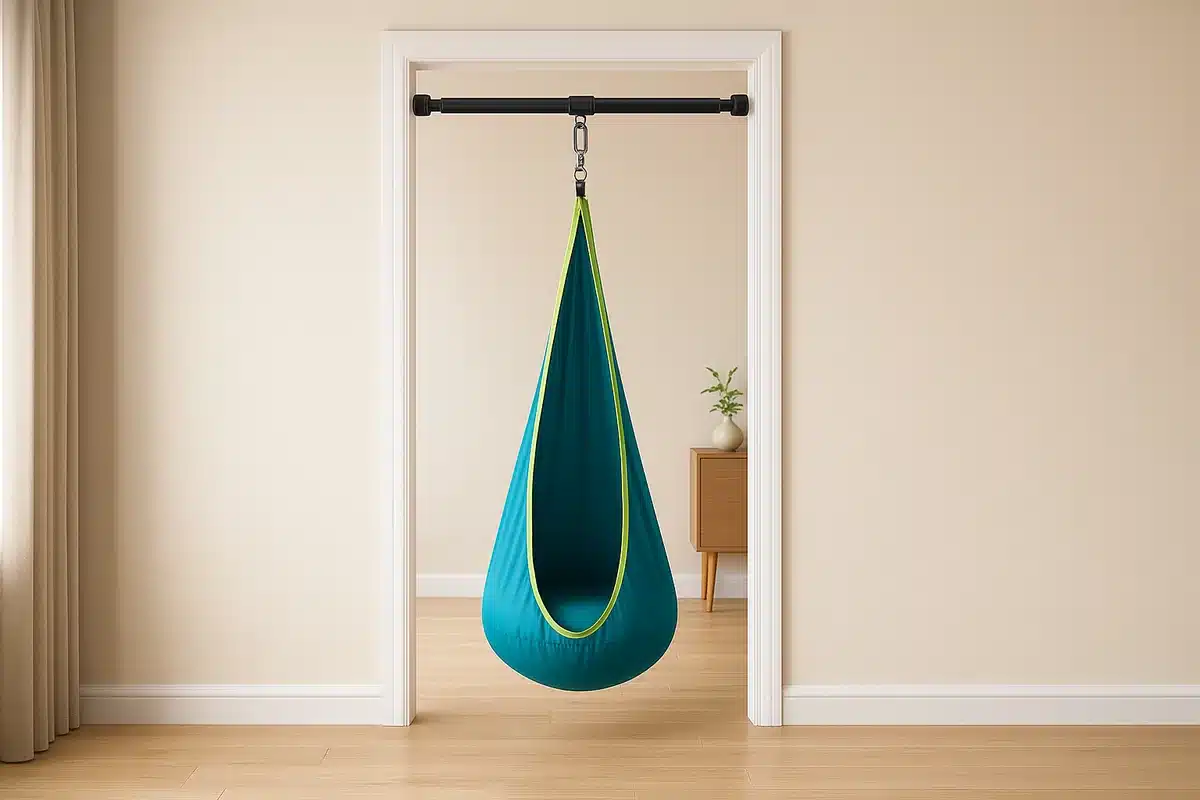
Doorway setups usually work best when you need something removable, you do not have the floor space for a stand, and the person using the swing wants calmer, more contained movement rather than wide, energetic arcs.
What doorway setups are usually good at
- Easy to remove when you do not want a swing out all day.
- Lower commitment for rentals, shared homes, and testing whether a swing is even helpful.
- Good match for cocoon, pod, or compression-style swings used for calmer input.
- Useful when the goal is a short reset, quiet cocooning, or a predictable movement break.
Where doorway setups often fall short
- The doorway itself limits side-to-side range and overall movement.
- Not every frame, trim profile, or hallway layout is a good fit.
- They can feel less ideal for bigger bodies, stronger movers, or anyone who wants a more open swing experience.
- They are often not the best match for platform-style movement or for people who need more generous clearance.
If you are mainly deciding between a removable doorway setup and a freestanding base, read the sensory swings with stands guide next. It helps clarify when a stand earns its footprint.
Stand setups: when they make more sense than doorway bars
A stand setup usually makes more sense when the room can handle the footprint and you want a setup that feels less constrained than a doorway bar. Stands are often the better no-mount choice for people who want a more dedicated swing station, need more flexible positioning, or know the swing will be used often enough that repeated setup and takedown will get old quickly.
Stand setups often make sense when
- You have enough floor space for the base and safe clearance around it.
- You want the swing away from a doorway or hallway pinch point.
- You are shopping for a home setup that stays more consistently available.
- You want a path that can feel more realistic for some teens or larger users than a basic doorway bar.
Tradeoffs to keep in mind
- Stands take up visual and physical space even when the swing is not in use.
- They can be awkward in multipurpose rooms.
- Heavier movement still needs honest respect for ratings, clearance, wobble, and flooring.
- Portable on paper does not always mean convenient in real life.
For more on floor space, room fit, noise, and what works indoors, see what works indoors. That page is where the room realities become much clearer.

What no-mount setups usually do not do well
This is where many people get frustrated. They buy a no-mount setup expecting it to feel like a ceiling-mounted swing in a larger open space, and it simply does not. No-mount setups are often a compromise solution. Sometimes that compromise is totally worth it. Sometimes it is not.
| Path | Usually strongest for | Common limitations |
|---|---|---|
| Doorway setup | Removable, lower-commitment, calm cocoon-style use | Tighter movement path, doorway fit issues, less ideal for bigger bodies or stronger movement |
| Stand setup | More dedicated no-mount use, better clearance than a doorway bar, more flexible room placement | Large footprint, room takeover, wobble and flooring concerns, still not the same as a permanent structural mount |
| Renter-safe alternative | People who need the sensory goal without a full swing setup | Does not fully copy swing movement, but may be more realistic and easier to live with |
No-mount setups also tend to be a weaker match when someone wants very active spinning, lots of open movement, or a setup that needs to scale well for larger bodies over time. In those cases, it is smart to compare with the adult sensory swings guide so capacity, size, and realistic home fit are not treated as an afterthought.
Apartment and renter considerations
For renters, the main question is not just, “Can I avoid drilling?” It is also, “Will this setup actually work in the room I have?” A doorway option may avoid holes but still create friction if it blocks circulation, clashes with trim, or turns a frequently used doorway into dead space. A stand may avoid the ceiling but still dominate a bedroom or shared living area.
- Small apartments: doorway setups often win on storage and footprint, but only if the doorway itself is a practical place to use the swing.
- Shared walls and downstairs neighbors: calmer movement is usually easier to live with than repetitive active swinging.
- Multipurpose rooms: stands are easier to place than doorway bars in some homes, but they are harder to ignore visually.
- Temporary living situations: lower-commitment options often make more sense than building the room around a big setup.
Sometimes the best renter decision is to skip the swing entirely and solve for the sensory need another way. If that may be your situation, explore renter-safe movement alternatives before spending money on a setup that may end up unused.
Kids, teens, and adults: size and movement differences
No-mount setups can work across ages, but they do not scale equally well. A setup that feels fine for a smaller child doing calm cocoon time may feel cramped, less stable, or less satisfying for a teen or adult who wants more room, more capacity, or stronger movement.
Kids
For younger kids, doorway and stand setups can both work when the goal is predictable, moderate movement and the room is arranged safely around the swing.
Teens
Teens often care just as much about room fit and how childish a setup feels as they do about movement. This is one reason stand setups sometimes make more sense than a visible doorway arrangement. It is also why some families do better with calmer, more discreet alternatives instead of trying to force a traditional sensory swing look into a teen room.
Adults and larger bodies
This is where honesty matters. Higher-capacity use needs careful attention to the swing, the support system, and the kind of movement the person actually wants. If that sounds relevant, do not stay trapped in kids-only advice. Read the adult sensory swings guide so you can judge whether a no-mount route is realistic or whether another path is smarter.
When a no-mount setup is not the best choice
A no-mount setup is probably not your best option when any of these are true:
- You want broad, active movement and have already been disappointed by tight or constrained setups.
- The user is likely to need higher-capacity or higher-clearance options right away.
- The room is so tight that the setup will always be in the way.
- You are trying to solve for a sensory need that might be met better by rocking, gliding, compression, crash input, or another non-swing option.
- You mainly want a renter-safe option because drilling feels intimidating, not because the room truly supports a good no-mount experience.
Do not force a swing just because it sounds ideal. The best setup is the one that fits your room and gets used. If a no-mount swing feels like a compromise too far, see renter-safe swing alternatives and solve for the sensory goal instead.
If you are still confident a no-drill setup is the right path, the next step is comparing actual buying paths instead of guessing. See the best no-mount sensory swing options.
FAQ
What is the best no-mount sensory swing setup for renters?
It depends on what the room can support. Doorway setups are often the easiest removable option for calm, contained use. Stand setups can be the better no-mount choice when the room has enough floor space and the user needs a setup that feels less constrained.
Are doorway sensory swing setups safe?
They can be appropriate when used exactly as intended, in a compatible doorway, with the right kind of swing and realistic movement expectations. They are not a blank check for any body size, any doorway, or any style of swinging.
Is a swing stand better than a doorway bar?
Usually, a stand is better when you want more room, more consistent setup, and a more dedicated home station. A doorway bar is better when removable convenience matters more than range or room feel.
Can adults use no-mount sensory swings?
Sometimes, but adult use needs closer attention to capacity, clearance, body size, and movement style. That is why it helps to compare with the adult sensory swings guide before assuming a light-duty no-mount setup will feel good long term.