
Calm corner guide for families
How to Create a Calm Down Corner for Kids: Setup, Ideas & What to Include
A calm down corner is a predictable place where a child can pause, lower the load around them, use a support, and figure out what comes next. It does not need to be expensive, Pinterest-perfect, or used as a timeout. This guide walks through where to put one, what to include, how to teach the routine, and what to change when it is not helping.
- Home calm corner setup
- What to put in it
- Visual and sensory supports
- Teaching and return routines
Quick start
How to set up a calm down corner without overcomplicating it
If you want the short version, start here. A useful calm corner can be small.
- Choose a lower-load spot. Look for somewhere with less noise, traffic, glare, and visual clutter while still allowing appropriate supervision.
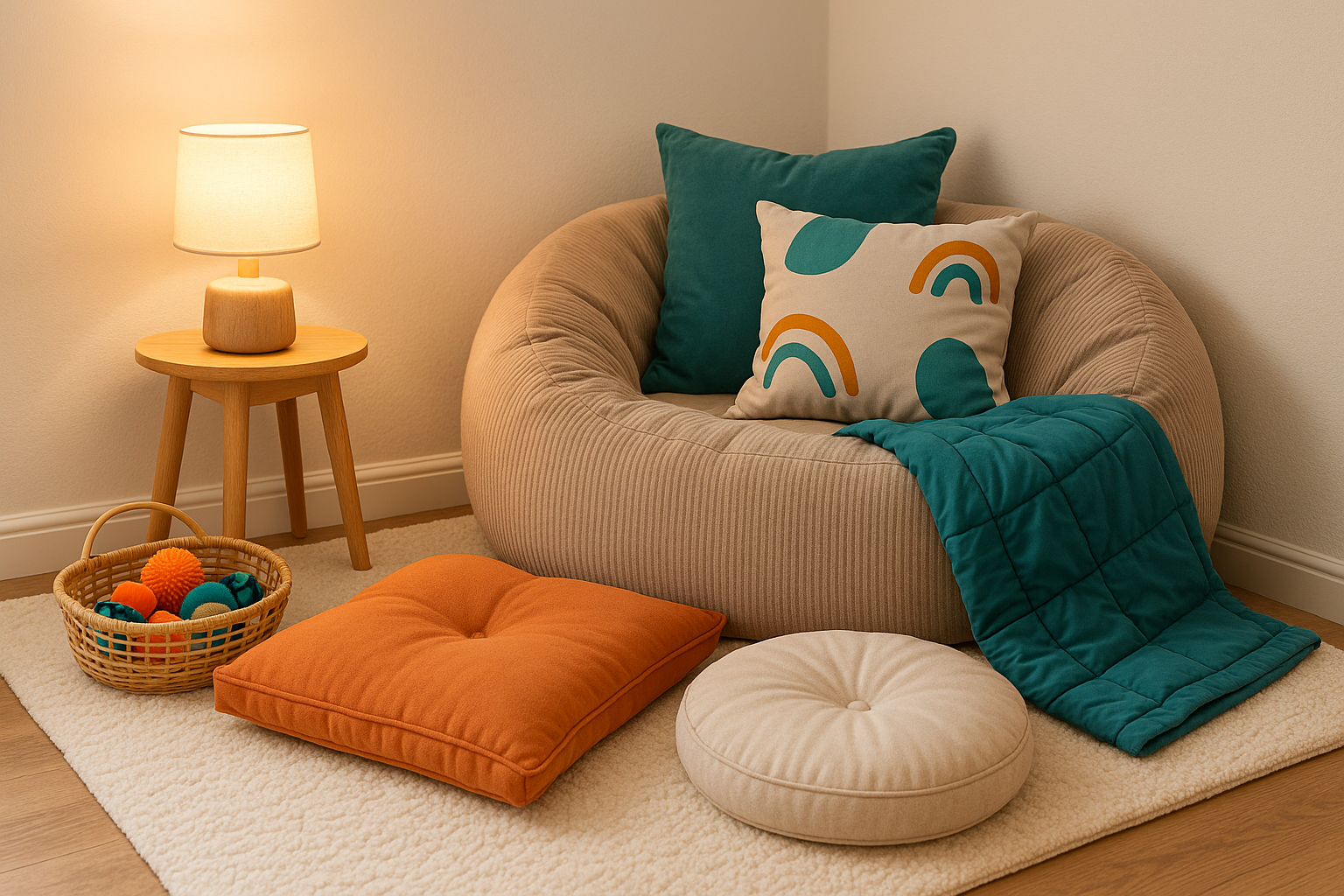
- Add one comfortable place to land. A floor cushion, bean bag, soft rug, or regular chair may be enough.
- Add one visual support. Use a simple calm corner poster, feelings chart, or support-choice board.
- Add two or three supports that match the child. Think quiet, movement, hands-busy, pressure, or communication — not a random bin of sensory toys.
- Teach the whole routine before it is needed. Practice going there, choosing a support, checking what is needed next, and returning.
A good first setup can be one seat + one visual + two supports. Add more only after you see what the child actually uses.
What is a calm down corner?
A calm down corner — also called a calm corner, calming corner, regulation corner, or quiet reset space — is a small, predictable place a child can use when they need less input, more support, or a pause before continuing with the day.
The space itself is only part of the support. What makes it useful is the pattern around it: the child knows where the space is, what the tools are for, how to ask for or accept support, and what can happen after the break.
A calm corner can be a dedicated corner of a bedroom or playroom, but it does not have to be. In a small home it may be one chair beside a basket. In a shared room it may be a floor cushion, headphones, and a small set of visuals that come out when needed.
The goal is not “go away until you are calm.” The goal is to make a hard moment easier to move through with less demand and a clearer next step.
Calm corner vs. time-out
A calm corner can stop feeling supportive if it is used mainly as a consequence. The difference is less about the furniture and more about how the space is introduced and used.
| Supportive calm corner | Punitive use |
|---|---|
| Used to reduce load and make support easier to access | Used mainly after behavior as a consequence |
| Can include an adult, co-regulation, help, or fewer demands | Requires the child to manage alone before they can return |
| Taught and practiced during neutral moments | Introduced only during conflict |
| Has a flexible, understandable return path | Return depends on proving the child is “calm enough” |
Before you buy anything
Start with what is making the moment hard
The best calm corner is not the one with the most sensory products. It is the one that changes the kind of friction the child is actually dealing with.
Before choosing furniture, fidgets, lights, or posters, think about what tends to happen before the child needs a break. Is the room too loud? Are there too many people or questions? Does the child need movement? Do words become hard? Does the transition back feel impossible?
If sound is the problem
Choose a quieter location if possible. Reduce background sound, keep talking brief, and consider sound-reduction options such as well-fitting hearing protection when appropriate.
If visual load is the problem
Use a clearer wall, fewer displayed tools, softer lighting, and closed or limited storage. A calm corner does not need to look empty, but it should be easy to take in.
If movement helps
Do not force the space to be completely still. Leave room for a stretch, wall pushes, rocking, a short movement option, or a visual movement card if those supports help.
If body pressure helps
Supportive seating, pillows, a lap-based pressure option, or other familiar body input may fit. Weighted products are optional, not automatic; use them only when they are appropriate for the child and situation.
If words get hard
Put a feelings chart, “I need” visual, support-choice board, or a few calming cards within reach so the child can point instead of having to explain everything verbally.
If returning is the hard part
Make the next step visible before the break starts. A First-Then cue, one-step return plan, or adult check-in can make the calm corner feel like a bridge instead of a dead end.
For a broader look at sound, movement, pressure, touch, and other sensory patterns, use the Sensory Inputs Guide. For environmental changes beyond one calm corner, see Sensory-Friendly Spaces.
Where should a calm corner go?
The best location is quieter than the busiest part of the room but not so hidden that the child feels isolated or cannot get appropriate support. Look at the space from the child’s point of view rather than choosing an empty corner simply because it is available.
Look for
- less foot traffic and fewer interruptions
- lower noise when possible
- less direct glare or harsh light
- enough room to sit comfortably
- easy access to the supports the child uses
- appropriate visibility and supervision
Try to avoid
- the loudest doorway or household traffic path
- placing it directly beside high-interest toys
- a spot that feels like exile or punishment
- crowding the corner with shelves and decorations
- a location that requires a difficult transition to reach
Can a calm corner work in a small space?
Yes. A permanent dedicated corner is not required. A small-space version can be one chair, a folded floor cushion, a small basket, and a visual stored nearby. The support routine matters more than square footage.
How to create a calm down corner step by step
- Choose the job of the space. Decide whether the main need is less sensory input, a place to move, easier communication, a short pause, or some combination of those.
- Choose the location. Lower avoidable noise, traffic, clutter, and glare before adding special equipment.
- Add one clear landing place. Use seating the child can get in and out of comfortably. A regular chair may work just as well as specialty furniture.
- Add a visual anchor. Pick one poster, feelings chart, routine cue, or support board that has a clear purpose.
- Add a small number of supports. Choose a few tools that match what you already know about the child instead of filling a bin “just in case.”
- Decide how help works. Can the child ask for quiet, space, help, movement, or an adult nearby? Make those options obvious.
- Decide what happens next. Build the return step into the routine from the beginning.
- Practice during a neutral moment. Show the space, try one support together, and practice leaving it before expecting the routine to work during overload.
Free setup help
Use the home calm corner checklist
If you want a one-page reminder while you set up the space, use the free home setup checklist rather than trying to remember every part of this guide.
What to put in a calm corner
Choose by purpose. You do not need one item from every category.
Comfort
A floor cushion, bean bag, rug, regular chair, pillow, or another familiar place to sit. Prioritize comfort, stability, and easy access over novelty.
Visual support
A calm corner poster, feelings chart, support-choice board, “I need” cards, First-Then support, or another visual that makes the routine easier to understand.
Quiet / sound support
A quieter location, hearing protection, predictable background sound, or simply fewer people talking at once may reduce the sound load.
Hands-busy support
One or two quiet tactile tools such as putty, a soft textured item, a simple fidget, or another familiar hands-busy option.
Movement support
Wall pushes, stretching, rocking, a movement card, or nearby room to move can be more useful than asking a movement-seeking child to sit completely still.
Pressure / body support
Pillows, supportive seating, a lap-based support, or another familiar pressure option may be useful for some children. If you are considering weighted tools, review the safety and fit questions first rather than assuming weight is automatically calming.
Time / predictability
A visual timer can help some children understand what is happening next. It should support predictability, not become a countdown demanding that the child regulate on schedule.
Visual supports
Start with the free calm corner printables
Download the free calm corner poster, feelings chart, support choices board, and calming-card starter resources before buying generic visual bundles.
Choosing physical supplies?
Use the shopping guide after you know what job the product needs to do
The dedicated calm corner buying guide compares practical options for seating, visual time, sound reduction, quiet tactile support, storage, and other setup needs.
What not to put in a calm corner
More is not automatically better. If the corner becomes busy, highly exciting, or difficult to manage, it can work against the reason you made it.
- A giant mixed toy bin: too many choices can turn the space into free play or make choosing harder.
- Flashing, loud, or unpredictable items: skip them when the child is already dealing with too much input.
- Tools the child dislikes: a popular “sensory” product is not useful if it feels irritating or uncomfortable to that child.
- Long rule posters: keep instructions short enough to use during a difficult moment.
- Anything framed as a punishment: signs or language that communicate exclusion can undermine trust in the space.
- Unsafe or poorly supervised equipment: hanging, weighted, climbing, or other specialized equipment needs appropriate setup and use.
Calm corner ideas for different homes and needs
You do not need a themed room. These calm corner ideas are intentionally simple so they can fit real homes, different budgets, and different regulation needs.
Small-space calm corner
Use one chair or floor cushion, a narrow basket, a feelings or choices visual, and one or two quiet supports. Store the basket elsewhere if the room cannot hold a permanent setup.
Low-budget calm corner
Start with what you already own: a comfortable seat, a blanket or pillow, free printable visuals, a familiar tactile item, and a quiet activity. Buy something only when you can name the gap it fills.
Low-input calm corner
Prioritize less clutter, softer or indirect light, fewer displayed options, sound reduction, and a simple visual. This setup is less about adding stimulation and more about removing avoidable input.
Movement-friendly calm corner
Leave space to stand, stretch, push against a wall, rock, or choose a short movement break. A child who regulates through movement does not have to use the corner as a stillness zone.
Bedroom calm corner
Keep it visually simple and separate it from punishment or forced isolation. A reading light, comfortable seat, familiar comfort item, and a few discreet supports may be enough.
Shared family-room calm corner
Use contained storage and a consistent seat so the support is easy to access without making the room feel like a dedicated therapy space.
How to teach a child to use a calm corner
Do not wait for the hardest moment to explain the routine for the first time.
- Introduce the space while the child is regulated. Keep the explanation short and neutral.
- Show what each support is for. Avoid assuming the child will know how to use a chart, timer, card, or sensory tool just because it is available.
- Practice one simple sequence. For example: notice → go to the space → choose one support → check what is needed next.
- Model asking for help. Make it clear that using the calm corner does not mean the child must solve everything alone.
- Keep choices manageable. Offer two or three options rather than asking “What do you need?” when that question is too broad.
- Practice leaving the space, too. The return is part of the routine, not an afterthought.
Lower-demand language: “Want less talking or help choosing?” can be easier to answer than a string of questions about why the child is upset.
A calm corner can include co-regulation
Some children settle best with another person nearby. That might mean an adult sitting quietly, reducing language, offering a familiar support, helping block extra input, or simply staying available. A calm corner does not have to be a place where a child is expected to independently self-regulate before receiving connection.
As the routine becomes familiar, some children may use more of it independently. Others may continue to need adult support, especially during bigger overload, difficult transitions, or unfamiliar situations.
Do not skip this part
A calm corner needs a return path
Many calm-corner routines explain how to enter the space but not what happens afterward. That can make the corner feel like a holding area instead of a useful support.
The return does not always mean going straight back to the exact same demand in the exact same way. The next step depends on what made the moment hard and what the child can manage now.
The next step might be
- returning to the original activity
- returning with adult help
- doing a smaller first step
- asking for a modification
- switching to a necessary transition
- finishing later when appropriate
Make it predictable with
- a First-Then visual
- a one-step “next” card
- a visual timer when time predictability helps
- a brief adult check-in
- a choice between two realistic next steps
Think bridge, not destination. The calm corner should help connect a difficult moment to a more manageable next step.
Calm corner rules, expectations, and time limits
A long rule list usually makes the space harder to use. Keep expectations tied to safety, access, and what the routine is for.
Simple expectations might be
- use the tools safely
- choose only a few things at a time
- ask for help, quiet, or space if needed
- keep shared items in the area
- check what comes next before leaving
Does a calm corner need a timer?
Not always. Some children benefit from seeing how long a short break will last. Others need more recovery time after genuine overload. A timer can support predictability, but it should not become a countdown demanding that a child feel regulated by a particular second.
Instead of choosing one universal number of minutes, pay attention to the purpose of the break. A brief frustration reset, after-school decompression, and recovery after sensory overload are not the same situation.
Calm corner ideas by age
Toddlers and preschoolers
Keep the routine very concrete. Close adult support, a familiar comfort item, one or two simple pictures, and a comfortable spot usually matter more than a large selection of tools. The adult may do much of the co-regulating.
Elementary-age children
This can be a useful age for feelings visuals, support-choice boards, a small number of sensory tools, and practicing a predictable return routine. Keep language simple enough to use under stress.
Tweens and teens
Prioritize dignity, privacy, and choice. A neutral chair, headphones, lower lighting, a journal, discreet tactile support, or a less childlike visual may fit better than cartoon-heavy calm corner decor.
Older teens and adults may prefer to think in terms of a reset space, sensory-friendly room, quiet zone, or decompression spot rather than a “calm corner.” For adult-specific environmental support, see Sensory Support for Adults.
Home calm corners and classroom calm corners are not exactly the same
At home, the space can usually be more individualized around one child’s preferences and family routines. In a classroom, the space has to work within a shared environment, staff routines, supervision, transitions, and multiple students.
| At home | In a classroom |
|---|---|
| Can be tailored closely to one child | Usually needs a simple shared structure |
| May use familiar comfort items and family routines | Needs durable, easy-to-reset tools and clear access expectations |
| Break length can flex around the situation | Return to instruction and classroom flow need explicit planning |
| Storage and appearance can be more personal | Low stigma and predictable use across students matter more |
For educators
Use the dedicated classroom calm corner guide
The classroom guide goes deeper on placement, what to include and leave out, rules, timing, teaching the routine, age adaptations, and troubleshooting in a shared learning environment.
What to change when the calm corner is not working
A child refusing, staying indefinitely, playing with everything, or getting more upset does not automatically mean the idea failed. Look at what part of the setup or routine is creating friction.
| What is happening | What to check |
|---|---|
| The child refuses to go | Was the space introduced only after conflict? Does it feel like punishment? Practice during calm moments and make support optional where possible. |
| The child plays with everything | There may be too many high-interest tools. Reduce the choices and keep only the supports that have a clear job. |
| The child gets more upset there | Look at sound, lighting, questions, isolation, uncomfortable seating, or whether the chosen sensory tools are actually unwanted input. |
| The child never wants to leave | The outside demand may still be too hard, the return step may be unclear, or the corner may have become the most rewarding area in the room. Clarify the next step instead of simply shortening the break. |
| The visuals are ignored | Make sure the visuals were taught first, are easy to understand, are physically reachable, and are limited to choices the child can actually use. |
| The timer causes more stress | Use a timer only if seeing time helps. Try a softer transition cue, a check-in, or a visible “next” step instead. |
Do not judge the corner by whether it stops behavior quickly. A better question is whether the setup reduces unnecessary load, makes support easier to access, and helps the child move toward a workable next step.
Frequently asked questions about calm down corners
What is the difference between a calm corner, calming corner, and calm-down corner?
Most families and schools use the terms to describe the same general idea: a predictable place for pausing and using regulation supports. The name matters less than how the space is used.
What should I put in a calm corner first?
Start with one comfortable place to sit, one useful visual, and two or three supports that fit the child. You can add or remove tools after you see what actually helps.
How long should a child stay in a calm corner?
There is not one ideal number of minutes for every child or situation. A short reset may be enough after frustration, while recovery after overload may take longer. Focus on the purpose of the break and the next workable step rather than a universal time limit.
Should a calm corner have a timer?
Only if a timer makes the routine more predictable for that child. If countdowns create pressure or more distress, use another cue for what happens next.
Can a calm corner work in a small house or apartment?
Yes. A chair, cushion, small basket, and a few portable visual supports can create a usable calm corner without a dedicated room or permanent installation.
What if my child does not want to use the calm corner?
Check whether the space feels punitive, uncomfortable, overstimulating, or too demanding. Introduce it during calm moments, reduce the number of tools, and avoid making the child prove they are upset “correctly” before receiving support.
Should an adult stay with a child in the calm corner?
Sometimes. Some children want space; others regulate better with a trusted adult nearby. The goal is not forced independence. Offer the amount of presence and help that makes the moment more manageable.
Do calm corners work for older kids and teens?
They can, but the setup should respect age, privacy, and preferences. Older kids may prefer neutral furniture, headphones, lower lighting, discreet supports, and a name like reset space or quiet zone.
Do I need special sensory equipment?
No. Start by changing the environment and using familiar supports. Specialty products are optional and should fill a specific need rather than define the space.
Keep going with calm corner help
Use the next page that matches what you are trying to do now.
SensoryGift content is educational and informational and is not a substitute for individualized medical, mental health, educational, occupational therapy, or safety advice. Use equipment and sensory supports in ways that are appropriate for the individual child and setting.